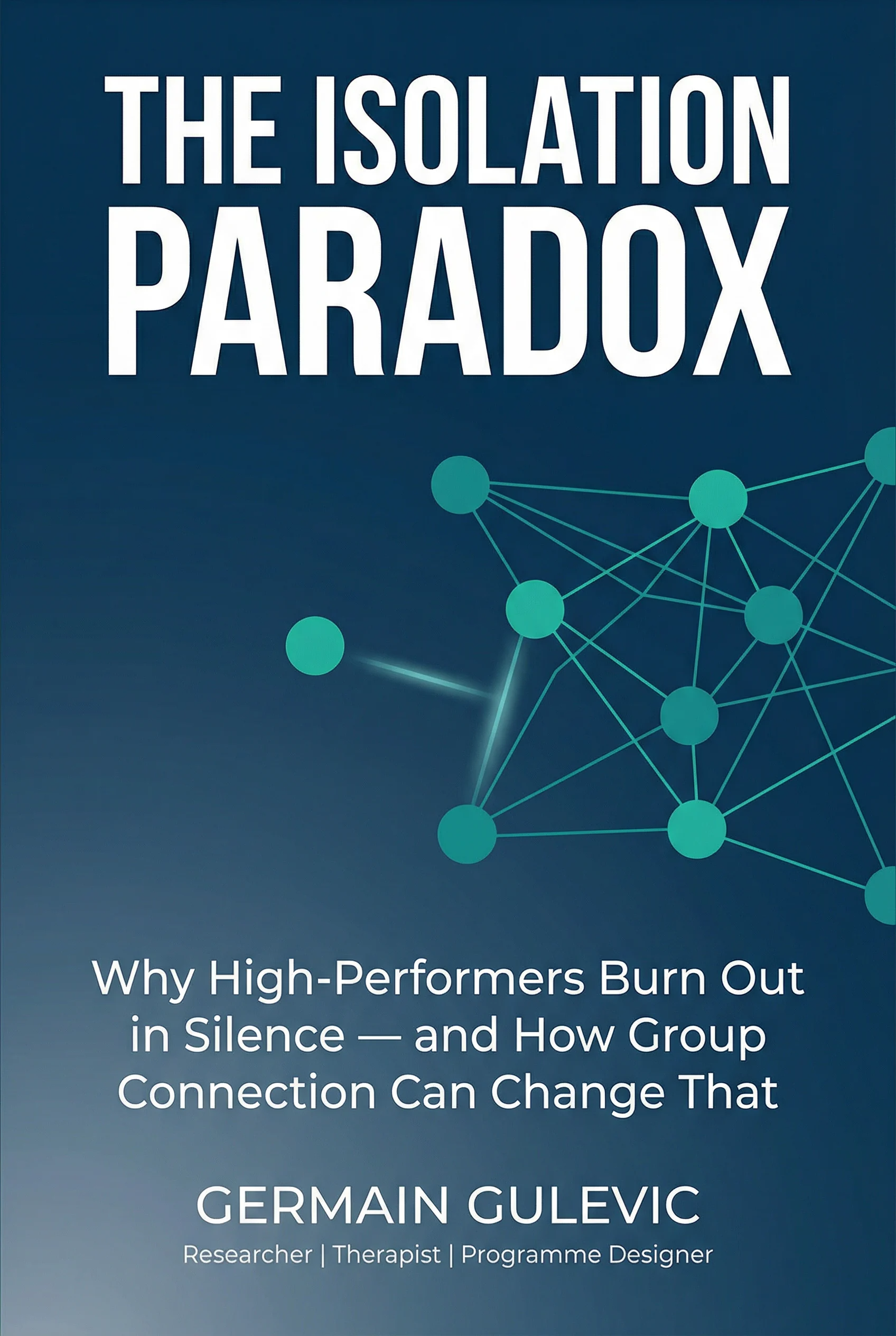
Evidence-Based Solutions for Professional Burnout
Why high-performers burn out in silence — and how group connection can change that. Based on original research with 72 high-stress professionals.
Available in PDF, EPUB, and Paperback (Amazon).
- Discover why isolation — not workload — drives burnout
- Practical frameworks for both professionals and practitioners
- The proven group intervention model that works
By Germain Gulevic · Researcher | Therapist | Programme Designer
The Scale of the Crisis
Something is terribly wrong with how we support the people who hold our world together.
Not in a vague, hard-to-measure way. In a documented, statistically undeniable way that shows up in sick leave records, early retirement figures, and the quiet exhaustion of people who are extraordinarily good at what they do.
of all work-related ill-health is stress
working days lost every year
annual cost to the UK economy
surge in government mental health spending since 2019
Stress prevalence across high-pressure professions
Sources: CIPHR 2023, Junior Lawyers Division 2019, Legatics & YouGov 2022, Police Federation 2023, BASW 2022, Education Support 2024, NHS Employers 2024
The Core Discovery
The Professional Isolation–Connection Paradox
The professionals most affected by burnout aren't socially isolated. They're surrounded by people constantly — leading teams, treating patients, teaching classrooms. And yet, many describe a deep feeling of being completely alone.
That's not a contradiction. It's a mechanism.
The traits that make high-achieving professionals effective — self-reliance, composure under pressure, the ability to keep going when others would stop — are the same traits that cut them off from genuine connection. The result is a particular kind of loneliness that doesn't look like loneliness from the outside. It looks like competence. It feels like being trapped.
The Caring Professions
Healthcare, teachers, social workers
Stress from relational and identity-based damage that accumulates over time. Emotional labour, moral distress, and compassion fatigue — traditional resilience programmes rarely touch this.
High-Accountability Roles
Lawyers, managers, senior leaders
High levels of scrutiny in cultures that treat vulnerability as incompatible with competence. Reputational concerns and billable-hour pressure create silent, accumulating stress.
Public Safety
Police, paramedics, first responders
Acute trauma combined with chronic organisational stress. Paramilitary structures limit conversation, and seeking help can feel like career suicide.
The research is clear
Professional isolation scores correlated directly with greater interest in group-based interventions, preference for sustained multi-session formats, and stronger desire for peer support. The more isolated a professional feels, the more they want structured peer connection — and the more experienced they are, the stronger that desire becomes.
What's Inside
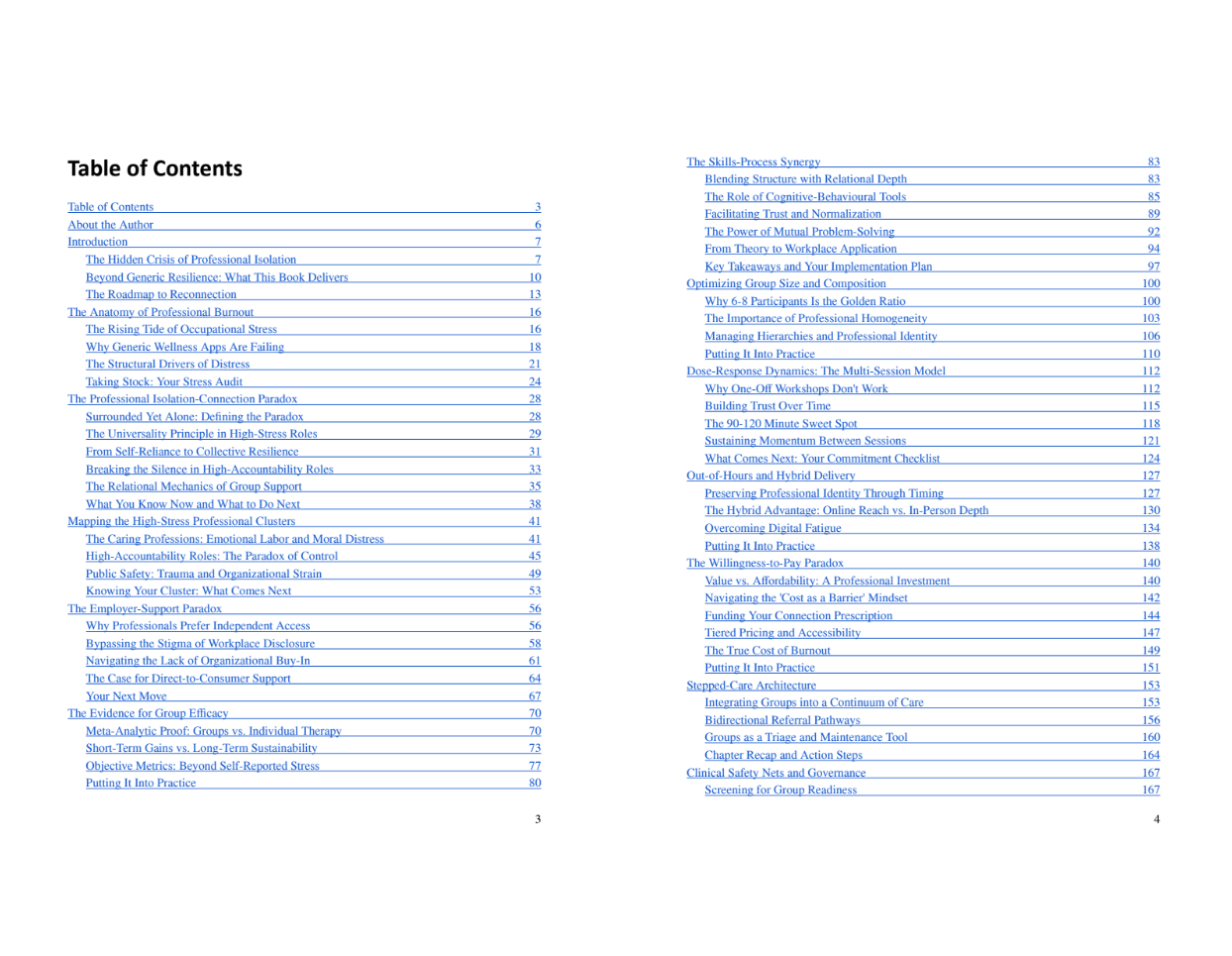
A Complete Framework — Not a Generic Self-Help Book
The Isolation Paradox translates rigorous research into practical tools for professionals and practitioners alike. Every recommendation is grounded in evidence.
The Anatomy of Professional Burnout
Why generic wellness apps are failing and what the structural drivers of distress really look like.
The Isolation–Connection Paradox
From self-reliance to collective resilience — and why universality is the most powerful therapeutic mechanism.
The Skills-Process Synergy
Blending CBT tools with relational depth. Skills without community is not enough.
Dose-Response Dynamics
Why one-off workshops fail, and how multi-session formats build trust and lasting change.
Clinical Safety & Governance
Screening, confidentiality, inclusion criteria, and managing risk in group settings.
The Phased Implementation Roadmap
From pilot to permanent service — a practical, step-by-step guide to building what works.
What makes this book different
- Based on original research with 72 high-stress professionals
- Practical tools for both professionals experiencing burnout and practitioners designing support
- The complete integrated service model — six sessions, three phases, four guiding principles
- Actionable exercises at the end of every chapter
- Clear pricing, positioning, and business model guidance for practitioners
Read the Introduction — Free
Not sure if this book is for you? Start with the Introduction chapter and discover the hidden crisis of professional isolation, what this book delivers, and the roadmap to reconnection.
- The Hidden Crisis of Professional Isolation
- Beyond Generic Resilience: What This Book Delivers
- The Roadmap to Reconnection
Get the free Introduction chapter
Enter your email and we'll send it straight to your inbox.
Your email is kept confidential. No spam, ever.
About the Author

Germain Gulevic
Researcher · Therapist · Programme Designer
Germain's work focuses on occupational stress, professional isolation, and evidence-based group interventions for high-stress professionals. His research project — integrating survey responses from 72 professionals with interview insights from five experienced therapists — identified the Professional Isolation–Connection Paradox and the Employer-Support Paradox, strengthening the case for confidential, employer-independent, and therapeutically credible group-based support.
What Readers Are Saying
Verified reviews from Amazon readers
“A Groundbreaking, Empathetic Masterpiece on High-Performer Burnout”
One of the most profound and necessary books on mental health and organizational culture written in recent years. Gulevic — a researcher, therapist, and program designer — takes a scalpel to the toxic myth of the "invulnerable high-achiever" and offers a brilliant, evidence-based roadmap for recovery through the power of shared connection.
Shawn D Ross
May 19, 2026
“Being alone can sometimes lead to a stronger sense of connection”
I've been working so hard lately, and it's crazy how often the most driven people end up totally wiped out. This book really gets into why successful folks often suffer alone, which is a tough truth to face. But then it shifts to something really positive: how relying on others can actually fix that burnout. The author explains big ideas in a way that's super easy to get, even if I'm not into philosophy.
larry g. Jackson
May 19, 2026
“Isolation Paradox”
Explores the hidden cost of success in modern professional culture, revealing how high-achieving individuals often become increasingly isolated as expectations rise and vulnerability feels riskier. The book examines why driven leaders and top performers are especially prone to silent burnout — cut off from authentic support by perfectionism, competition, and the pressure to appear resilient.
Danielle DeMicco
April 23, 2026
“Data and Research Backed”
Are you a high performer at work who feels burnt out and stressed? This book seeks to answer why that happens and what you can do about it. Interesting insights and theories.
Joe
April 22, 2026
“A catalyst for developing effective interventions!”
This work identified two central findings — the professional isolation-connection paradox and the employer-support paradox — and strengthened the case for confidential, employer-independent, and therapeutically credible group-based support. The book is a translation from this research to practical use.
AvidShopper333
May 17, 2026
Available Now
Get Your Copy of The Isolation Paradox
Choose your preferred format and start transforming how you think about professional burnout and group connection.
Digital editions via gulevic.com · Paperback via Amazon